

What Is Naturalist Intelligence? Meaning, Traits, Careers, and Real-Life Examples
October 10, 2025Existential Intelligence: Meaning, Traits, Real-Life Examples, and How to Develop Your Deepest Way of Thinking
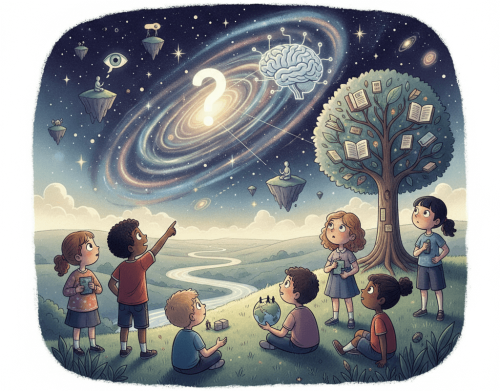
Human intelligence is often measured through logic tests, grades, or professional achievements. But there is another kind of intelligence that operates on a much deeper level—one that asks, Why are we here? What is the meaning of life? What happens after death? This is known as existential intelligence.
If you’ve ever found yourself contemplating the purpose of suffering, the nature of consciousness, or your role in the universe, you may already be engaging this form of intelligence.
This comprehensive guide covers:
- What existential intelligence really means
- How it fits into multiple intelligence theory
- Key characteristics and traits
- Real-world examples
- Practical ways to develop existential intelligence
- How it influences career choices and personal growth
- Frequently asked questions
What Is Existential Intelligence?
Existential intelligence refers to the ability to think deeply about fundamental questions of human existence. It involves reflection on life’s meaning, death, morality, spirituality, consciousness, and the nature of reality itself.
The term was popularized by psychologist Howard Gardner, who proposed the Theory of Multiple Intelligences. While Gardner did not formally include existential intelligence as one of the original eight intelligences, he acknowledged its potential as a distinct form.
Existential intelligence is the capacity to explore life’s “big questions” with depth, curiosity, and insight.
Existential Intelligence in the Theory of Multiple Intelligences
| Type of Intelligence | Description | Example Strength |
|---|---|---|
| Linguistic | Skill with words and language | Writers, speakers |
| Logical-Mathematical | Logical reasoning and numbers | Scientists, engineers |
| Spatial | Visualizing and imagining | Architects, designers |
| Bodily-Kinesthetic | Physical coordination | Athletes, dancers |
| Musical | Sensitivity to sound and rhythm | Musicians |
| Interpersonal | Understanding others | Counselors, leaders |
| Intrapersonal | Self-awareness | Psychologists |
| Naturalistic | Understanding nature | Biologists |
| Existential | Exploring meaning and life questions | Philosophers, theologians |
Key Characteristics of Existential Intelligence
1. Deep Curiosity About Life’s Meaning
Individuals frequently ask questions about purpose, existence, and identity.
2. Comfort with Abstract Thinking
They explore concepts like infinity, time, and consciousness without discomfort.
3. Sensitivity to Moral and Ethical Issues
They reflect on justice, fairness, and long-term impact.
4. Awareness of Mortality
They consider death not morbidly, but as a framework for meaningful living.
5. Search for Personal Purpose
They align life decisions with deeper values.
Real-Life Examples of Existential Intelligence
Philosophers and Thinkers
- Socrates
- Søren Kierkegaard
- Martin Luther King Jr.
- Rumi
Scientists
Cosmologists and physicists exploring the origins of the universe often engage existential inquiry.
Writers and Artists
Literature frequently explores themes such as identity, suffering, and free will.
How to Develop Existential Intelligence
1. Ask Better Questions
- Why does this matter?
- What kind of person do I want to become?
- What values guide my choices?
2. Read Philosophical Works
Explore accessible texts such as Man’s Search for Meaning by Viktor Frankl.
3. Practice Reflective Journaling
Write regularly about purpose, fear, legacy, and identity.
4. Engage in Meaningful Conversations
Seek discussions that go beyond surface-level topics.
5. Practice Mindfulness or Contemplation
Silent reflection builds clarity and depth.
Career Paths Suited for Existential Intelligence
| Career Field | Why It Fits |
|---|---|
| Philosophy | Direct engagement with life’s big questions |
| Psychology | Understanding human experience |
| Counseling | Helping others find purpose |
| Writing | Exploring existential themes creatively |
| Ethics & Policy | Shaping moral frameworks |
Frequently Asked Questions (FAQs)
Is existential intelligence measurable?
There is no standardized IQ-style test for existential intelligence. It is typically observed through reflective depth and philosophical engagement.
Can children have existential intelligence?
Yes. Children often ask profound questions about life and morality.
Is existential intelligence linked to religion?
It can be, but it does not have to be. Existential intelligence can be entirely secular.
Can it be developed later in life?
Yes. Reflection, reading, and meaningful dialogue can strengthen it at any age.