
Logical-Mathematical Intelligence: Traits, Examples, Careers, and How to Develop Analytical Thinking Skills
October 8, 2025
Bodily-Kinesthetic Intelligence Explained: Redefines Physical Learning and Human Potential
October 8, 2025How to Develop Visual-Spatial Intelligence?
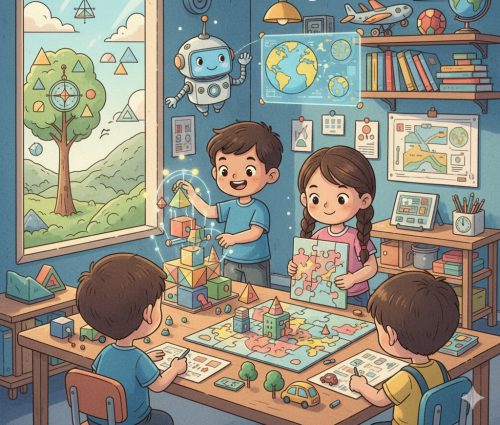
When we think of intelligence, many of us picture high test scores, strong vocabulary, or mathematical precision. But intelligence is far broader than standardized exams suggest. In 1983, psychologist Howard Gardner introduced a transformative framework known as the Theory of Multiple Intelligences, challenging the narrow view of IQ as the sole measure of human capability.
Among the eight (later nine) intelligences he proposed, visual-spatial intelligence stands out as one of the most fascinating—and often misunderstood. This form of intelligence shapes architects, artists, pilots, engineers, designers, surgeons, and even gamers. It influences how we navigate cities, assemble furniture, interpret maps, and imagine new possibilities.
What Is Visual-Spatial Intelligence?
Visual-spatial intelligence, according to Howard Gardner, refers to the ability to perceive, analyze, and mentally manipulate visual information in space. It involves understanding relationships between objects, distances, dimensions, and spatial orientation.
- Think in images rather than words
- Visualize objects from different angles
- Interpret maps, charts, and diagrams easily
- Recognize patterns in shapes and designs
- Remember visual details vividly
The Origins: Howard Gardner’s Theory of Multiple Intelligences
Howard Gardner, a developmental psychologist at Harvard University, proposed the Theory of Multiple Intelligences in his book Frames of Mind. He argued that traditional IQ tests measure only a narrow band of human ability—mainly linguistic and logical skills.
- Linguistic intelligence
- Logical-mathematical intelligence
- Musical intelligence
- Bodily-kinesthetic intelligence
- Interpersonal intelligence
- Intrapersonal intelligence
- Naturalistic intelligence
- Visual-spatial intelligence
Key Characteristics of Visual-Spatial Intelligence
1. Strong Visualization Skills
They can mentally rotate objects, imagine transformations, and picture scenes in detail.
2. Excellent Sense of Direction
They rarely get lost and can navigate unfamiliar places with relative ease.
3. Talent in Drawing or Design
They may sketch, doodle, or create visual representations to understand ideas.
4. Sensitivity to Color, Shape, and Form
They notice visual patterns others overlook.
5. Preference for Diagrams Over Text
Charts, blueprints, and visual aids help them learn faster than lengthy explanations.
6. Strong Puzzle-Solving Abilities
They enjoy jigsaw puzzles, 3D modeling, architecture games, or strategy-based video games.
Real-Life Examples of Visual-Spatial Intelligence
| Profession / Activity | How Visual-Spatial Intelligence Is Used |
|---|---|
| Architect | Designing structures in 3D space and visualizing how components fit together |
| Surgeon | Navigating complex internal anatomy with precision |
| Pilot | Interpreting spatial relationships in the air |
| Graphic Designer | Balancing visual composition, layout, and color |
| Engineer | Creating and interpreting technical drawings |
| Interior Designer | Visualizing how furniture and decor interact in a room |
| Photographer | Framing shots with depth, perspective, and composition |
| Video Game Developer | Designing immersive virtual environments |
Visual-Spatial Intelligence in Children
Signs of Visual-Spatial Intelligence in Kids
- Prefers building blocks over reading aloud
- Enjoys drawing detailed pictures
- Understands geometry concepts quickly
- Loves LEGO, puzzles, or Minecraft
- Learns better through images than lectures
- Thinks in pictures rather than words
How Schools Can Support Spatial Learners
- Use diagrams and visual organizers
- Incorporate project-based learning
- Encourage art and design activities
- Introduce 3D modeling tools
- Teach through videos and infographics
- Use mind maps instead of linear notes
Careers for People with Strong Visual-Spatial Intelligence
Creative Fields
- Graphic design
- Animation
- Architecture
- Industrial design
- Fashion design
- Photography
- Film production
Technical and STEM Fields
- Engineering (mechanical, civil, aerospace)
- Robotics
- Urban planning
- Data visualization
- Surgery
- Dentistry
- Aviation
How to Develop Visual-Spatial Intelligence
For Children
- LEGO sets and building kits
- Sketching objects from different angles
- Jigsaw puzzles and tangrams
- Creative Minecraft mode
- Treasure hunts using maps
For Adults
- Learn 3D design software
- Practice mental rotation exercises
- Take up photography
- Play chess or strategy games
- Explore virtual reality environments
Frequently Asked Questions (FAQs)
What is visual-spatial intelligence in simple terms?
It is the ability to think in pictures, understand how objects relate in space, and mentally manipulate shapes or images.
Is visual-spatial intelligence the same as artistic talent?
No. While many artists have strong spatial skills, this intelligence also applies to engineering, surgery, navigation, and scientific modeling.
Can visual-spatial intelligence be measured?
Certain cognitive tests assess spatial reasoning, including mental rotation tests and block design assessments. However, intelligence cannot be fully captured by standardized testing alone.
What jobs require strong spatial intelligence?
Architecture, engineering, aviation, graphic design, surgery, robotics, game development, and data visualization.
How can parents nurture visual-spatial intelligence at home?
Encourage building toys, drawing, puzzles, map-reading activities, and digital 3D tools.